Thresholds Outpatient and Intensive Outpatient Services are person-centered, trauma-informed, and evidence-based.
Our model is to bring a comprehensive suite of services to wherever our clients are.
Thresholds provides mental health crisis response in Chicago through two programs – our Living Room and our Mobile Crisis Response Team.
The Thresholds Workforce Development Department offers workshops, conferences and other training opportunities.
Thresholds offers groundbreaking programs for adolescents, young adults, families, young mothers, and their children.
Thresholds offers services designed to integrate mental health, substance use, and primary care treatment.
Our mission is to provide data to support decision-making meant to improve quality of care, optimize health outcomes, and lower costs.
The Centers provide a wide range of mental health and substance use treatment services to their immediate surrounding communities in Ravenswood and McHenry County.
The only program of its kind in Illinois, offering services for persons with mental illnesses who are deaf or hard-of-hearing.
Thresholds’ Peer Success program is operated by consumers – those who have a lived experience of mental illness.
Thresholds is the largest provider of supported housing in Illinois and provides comprehensive services for persons experiencing homelessness.
Thresholds provides clients with the support and services needed to achieve independence to class members of the Williams Consent Decree.
Thresholds offers services to members of the armed forces who are experiencing PTSD, trauma, substance use disorders, and much more.
Thresholds’ Employment Specialists place clients in jobs of their choice to create real economic independence.
The Thresholds Creative Arts Therapy team, made up of a diverse range of trained art therapists, provides our clients tools for wellness.
MindStrong Early Intervention is a comprehensive program for the diagnosis and treatment of individuals at Clinical High Risk for psychosis, also known as Attenuated Psychosis Syndrome (APS). Participants are screened at intake using a specialized assessment tool to determine program eligibility. The MindStrong Early Intervention team works with 13-25-year-olds to provide therapy and multi-disciplinary services, tailoring supports to each individual.
With the proper support and treatment, most young people who experience attenuated symptoms will not develop active psychosis. MindStrong Early intervention is aimed at symptom prevention and education that can assist a young person in overcoming current stressors in order to have a full and satisfying life!
Early Intervention services were established via a 2019 SAMSHA grant designating Thresholds to design services to identify and treat Clinical High Risk for psychosis (CHR-p), a condition that had formerly been addressed in research, but not in clinical practice. Through partnerships with the Chicago Early Intervention Network at Northwestern University, Rush Medical School, and others, Thresholds adapted the Coordinated Specialty Care model and developed innovative services to help young people and their families understand attenuated symptoms of psychosis and receive the best-fit treatment at the earliest stage.
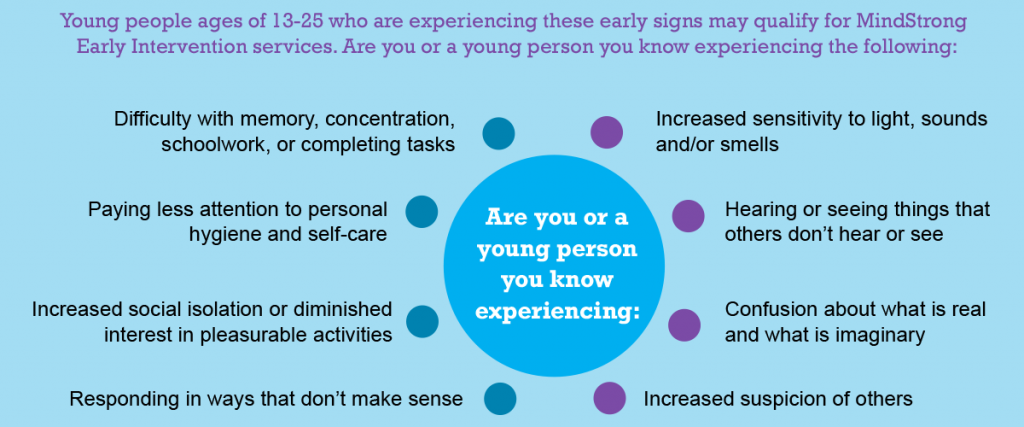
The word “attenuated” means a lesser variation of something. In this case, “attenuated” psychosis is characterized by psychosis symptoms (i.e., perceptual experiences, unusual beliefs, and/or disorganized thinking or speech) that occur in an attenuated, or lessened, form. These experiences are less severe, less distressing, and less frequent than those seen in psychotic disorders, and yet are still bothersome, interfering, or captivating.
Attenuated Psychosis Syndrome (APS) is a disorder in the main handbook healthcare professionals use to understand mental health diagnoses, the DSM. APS is characterized by attenuated psychotic symptoms that are recent (i.e., begun or worsened in the past year), frequent (i.e., at least once a week), distressing and interfering, and that need clinical attention.
APS is most common among 15–25-year-olds. People experiencing attenuated psychosis symptoms are often confused or perplexed by their experiences and recognize that they are not real. With APS, reduced motivation, lack of interest in socializing, anxious or depressed mood, a change in taking care of oneself, and/or a change in school/work performance are common too.
With the right treatment, recovery is expected. It is important to continually monitor attenuated psychosis symptoms. Working with a specialized treatment center designed for people with APS can be helpful for monitoring, assessing, and treating. It is also often helpful for individuals who meet criteria for APS to focus on their sleep and health behaviors, and to avoid substance use.
Individuals experiencing attenuated psychosis symptoms may also benefit from therapy designed specifically for APS. Cognitive Behavioral Therapy (CBT) can help people generate alternative helpful explanations for their experiences, facilitate adaptive coping strategies, navigate day-to-day life, and achieve goals. Thresholds MindStrong Early Intervention program is designed to provide targeted and young person-driven care to individuals with APS and their families.
*Content adapted from the Strive for Wellness Clinic, SFWMaryland.com