
Intern Spotlight: A Summer Spent with Thresholds
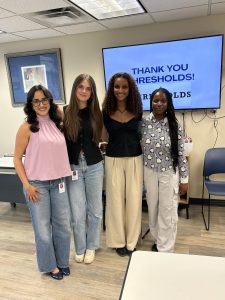
This summer, Thresholds welcomed four rising sophomores from the University of Notre Dame as interns through the ND Bridge Program, which connects students with organizations working to address complex social issues. For interns at Thresholds, this means diving headfirst into community settings where behavioral healthcare, housing, employment, and recovery connect every day.
Ady Bremner, Ella Dassah, Naomi Teklemariam, and Thea Bendaly spent eight weeks living and working in Chicago, learning alongside Thresholds staff and clients. They visited a variety of programs, shadowed staff, explored locations across the city, and researched topics rooted in bettering our communities.
At the end of their internships, each student presented their research to Thresholds clinical staff. Their topics ranged from healthcare barriers for people living with serious mental illness to the impact of hospital closures, social worker burnout, and the transition from institutional settings to community-based housing.
While each student came to Thresholds with a different academic background and career interests, their experiences connected their areas of study to the people and communities affected by the systems they’ve learned about.
Supporting the Supporters
For Naomi Teklemariam, a neuroscience major on a pre-med track, shadowing staff led her to a bigger question.
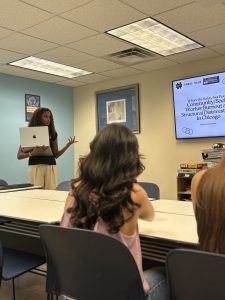
After conversations with staff about the demands of behavioral healthcare work, Naomi became interested in social worker burnout and its connection to structural disinvestment in Chicago’s West and South Sides.
“I really fell into this research question within my first week at Thresholds,” Naomi said. “I was talking with my supervisor and heard personal stories from staff about how they combat stress and burnout, which really drew me to this research focus.”
As Naomi explored the issue, she also saw how important it is for organizations to recognize and address those pressures. Her experience at Thresholds showed her that supporting staff is part of providing quality care to clients. By providing opportunities for staff to support one another, she saw an organization that acknowledges the realities of behavioral healthcare work while creating space for staff to sustain it.
Naomi’s research provided a valuable look at how decades of disinvestment in Chicago communities can contribute to the pressures facing social workers today. But she also saw the importance of workplace culture in helping staff manage that work.
“No matter the team, there was always so much laughter and mutual support between staff and clients. I think that made a huge difference in how that care was delivered and received,” she said.
Protecting Lifesaving Policies
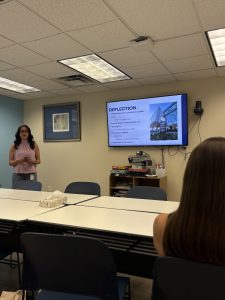 Thea Bendaly arrived at Thresholds eager to explore how criminal justice reform and mental healthcare connect in practice.
A political science major, Thea is involved in Notre Dame’s Student Policy Network and studies mass incarceration, reentry, and prison reform. She knew there was a connection between those issues and mental healthcare but wanted to better understand that connection firsthand.
“Homelessness, poverty, mental health care, and mass incarceration all intersect,” Thea said. For her, the eight-week internship offered a way to deepen her understanding of a social justice issue she hopes to work on throughout her career.
Through her experiences and research, Thea gained a deeper appreciation for funding advocacy and how dangerous cuts can be for clients.
“We talk so much in school about federal funding cuts,” Thea said. “Getting to actually interact with people who are affected by federal funding cuts has been really impactful for me.”
Her presentation focused on the Williams Consent Decree and the transition from institutional settings to community-based housing. Through her research, she explored how co-occurring substance use and serious mental illness can add complexity to the transition while finding that engagement and individualized support play an important role in successful community living.
Looking Beyond a Diagnosis
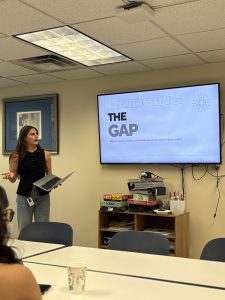 Ady Bremner’s research focused on a question that sits at the intersection of mental and physical healthcare: What factors make it challenging for people living with serious mental illness to access the healthcare they need?
As she spent time with Thresholds’ community teams, Ady saw how factors such as lack of transportation, financial resources, health literacy, and social stigma can create barriers to care. Those observations shaped her research, which explored the systemic challenges affecting healthcare access and the ways Thresholds works to address them.
Her time at Thresholds also reinforced the importance of seeing the whole person behind the services they receive.
“One of the biggest things I learned here was the value of not limiting clients to their diagnosis,” Ady said. “Being able to see someone for who they are and their humanity was a core memory for me.”
That perspective carried into the way she thought about healthcare disparities. Rather than viewing access to care as simply a matter of individual choices, Ady understood how much larger systems can influence a person’s ability to get the support they need.
“A lot of it isn’t a conscious choice by one person, but rather systematic barriers,” she said. “It’s about treating the entire person exactly as they are: a person!”
Seeing the Bigger System
Ella Dassah’s research examined another part of that system: the impact of hospital closures on behavioral healthcare access and advocacy. During her internship, Ella visited programs across Chicago’s West Side and western suburbs. She saw how much coordination goes into helping clients maintain stability and access care.
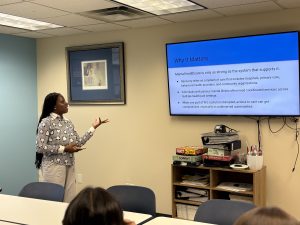
“Each experience gave me a valuable perspective on community mental health,” Ella said. “Nothing happens without everyone being all in and on the same team. I saw how much collaboration went into every effort.”
Her research examined how the closure of a “safety-net hospital” can create additional pressure throughout an already strained healthcare system. When one part of that system is disrupted, the effects can extend to emergency departments, community providers, and organizations like Thresholds that help people stay connected to ongoing care.
For Ella, the experience reinforced that behavioral healthcare cannot be viewed in isolation. It is part of a larger network of hospitals, primary care providers, community organizations, and other services that people rely on to stay healthy and connected to their communities.
Thresholds Takeaways
The students arrived with different interests, but each left with a similar sense of pride, understanding, and motivation to apply what they learned to their future. One of the biggest surprises they shared was the breadth of Thresholds’ work. After working alongside residential programs, employment services, clinical support, homeless outreach, and more throughout their eight weeks, the interns each noted the importance and impact of building relationships between staff and clients.
“I feel like we’ve all realized truly how involved staff are in the recovery and the mental health care of the people they serve,” Thea said. “The staff are there going through this journey alongside the clients, and are always putting their best foot forward.”
For the students, some of their favorite moments came from simply talking with clients. Seemingly small conversations about Marvel, sports, nature, future goals, and everything in between helped them see people beyond the diagnoses or systems they had been studying.
“I feel like most of my favorite memories were when we spent time with the clients,” Ella reflected. “I recommend that everyone come in with a really open mind and make the most of this opportunity. That’s what I did!”
Those conversations became an important part of the internship’s impact, challenging assumptions and giving the students a more personal understanding of the issues behind their research. As the students return to Notre Dame for the new school year, they take with them a deeper understanding of community-based care and the people who make it possible.
We are so grateful to Ady, Ella, Naomi, and Thea for their curiosity, thoughtfulness, and willingness to learn from our clients and staff throughout the summer. We wish them the best in the year ahead and look forward to seeing where their experiences take them!
Interested in gaining hands-on experience in behavioral healthcare? Explore internship and career opportunities at Thresholds and find your place on Team Thresholds: thresholds.org/careers